SOUTH-EASTERN ASIA · REGION GUIDE

Malacca

A river port where Malay sultans, European empires and Peranakan merchants left their marks within a walkable historic centre.

Book

Escapes Itineraries

Every trip we run through Malacca, including the ones that pass through on a longer route.

No trip runs here on its own yet

Read on — the guide below is the place, not the catalogue. Or tell us your dates and we will build one.

Ask about Malacca

Tell us

No trip here yet

We have not put a Malacca trip on the shelf yet, which is not the same as not going. Tell us what you want to see and how long you have, and your trip manager builds one around it.

Plan a Malacca trip

A person reads it and replies — no automated quote, and nothing to pay to ask.

Understand Malacca

The Story of Malacca

Malacca grew where the river meets the Strait: a 15th-century Malay port reshaped by Portuguese, Dutch and British rule, with Chinese Peranakan families turning maritime trade into a distinctive city culture.

Chapter 01 · ORIGIN

A Sultanate at the Strait

Around 1400, Parameswara established Malacca beside a river and one of Asia's busiest sea lanes. The Malacca Sultanate prospered by protecting merchants and linking trade between Ming China, India and the Indonesian archipelago. Portuguese conquest in 1511, Dutch rule from 1641 and British control after 1824 explain the city's layered identity.

Fact Ming admiral Zheng He visited Malacca during the early 15th century, reinforcing its relationship with China.

Chapter 02 · PEOPLE

Communities Made by Trade

The Malacca Sultanate drew Malay, Gujarati, Arab and Chinese merchants to its harbour. Chinese settlers and local Malay families formed the Baba-Nyonya community, while Portuguese descendants developed Kristang culture after 1511. Chetti families, whose roots connect to Tamil traders, added another locally specific community shaped by centuries of intermarriage.

Fact The Portuguese Settlement at Ujong Pasir was established in 1930 for Malacca's Kristang community.

Chapter 03 · FOOD

Cooking from the Shipping Lanes

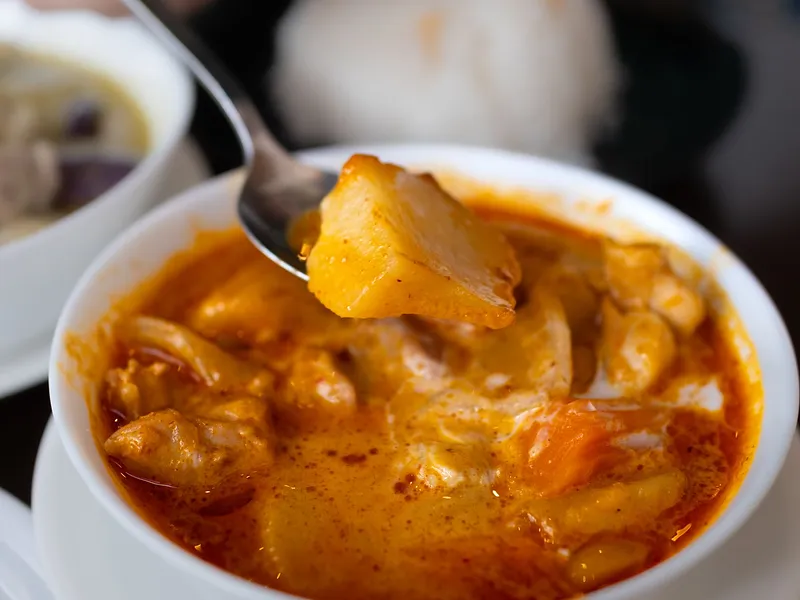
Malacca's kitchens reflect the same routes that enriched its 15th-century port. Nyonya cooks combined Chinese techniques with Malay ingredients such as pandan, coconut and belacan. Kristang households developed dishes including devil's curry, while Hainanese vendors shaped Malacca's chicken rice balls. Cencaluk, made from fermented shrimp, recalls the city's coastal geography.

Fact Malacca's chicken rice balls are associated with Hainanese vendors who adapted chicken rice for local customers.

Chapter 04 · ARCHITECTURE

Buildings of Successive Powers

Each ruling power rebuilt the same strategic centre. Portugal raised A Famosa after 1511; the Dutch completed the Stadthuys around 1650 and Christ Church in 1753. British authorities later altered St Paul's Hill and demolished most Portuguese fortifications in 1807. Chinese merchant wealth survives in Jonker Street shophouses and Cheng Hoon Teng Temple.

Fact Porta de Santiago is the surviving gate of A Famosa, built by the Portuguese in 1511.

Chapter 05 · NATURE

River, Strait and Migrating Raptors

The Melaka River gave the 15th-century port sheltered access to the Strait, while surrounding mangroves supplied fish, timber and coastal protection. Southwest of the city, Tanjung Tuan projects into the shipping channel. Its forested headland becomes a migration corridor in March, when oriental honey-buzzards and other raptors cross from Sumatra.

Fact Tanjung Tuan Forest Reserve was first gazetted in 1921 and protects coastal forest within Malacca.

Turning points

  1. c. 1400

    Malacca founded

    Parameswara establishes a port that becomes the Malacca Sultanate.

  2. 1411

    Ming alliance

    Parameswara visits Ming China, strengthening Malacca's diplomatic protection.

  3. 1511

    Portuguese conquest

    Forces under Afonso de Albuquerque capture the city.

  4. 1641

    Dutch takeover

    Dutch forces take Malacca after a five-month siege.

  5. 1824

    British control

    The Anglo-Dutch Treaty transfers Malacca to British administration.

  6. 1956

    Independence announcement

    Tunku Abdul Rahman announces Malaya's independence date at Bandar Hilir.

  7. 2008

    UNESCO inscription

    Melaka and George Town enter UNESCO's World Heritage List.

Discover

Experience Malacca

Mornings suit St Paul's Hill and the riverfront; evenings bring Jonker Walk food stalls, illuminated bridges and seafood beside the Portuguese Settlement.

A Famosa, Porta de Santiago

Bandar Hilir

A Famosa, Porta de Santiago

The surviving gate belonged to a Portuguese fortress begun after Afonso de Albuquerque captured Melaka in 1511.

St Paul's Church

Bandar Hilir

St Paul's Church

Portuguese colonists built the hilltop church in 1521; Dutch gravestones now line its roofless nave.

The Stadthuys

Bandar Hilir

The Stadthuys

Built under Dutch rule around 1650, the red complex served as the governor's administrative centre.

Christ Church Melaka

Bandar Hilir

Christ Church Melaka

The Dutch Reformed congregation completed this red-painted church in 1753 beside the Stadthuys.

Cheng Hoon Teng Temple

Jonker Walk

Cheng Hoon Teng Temple

Founded in the 17th century, Malaysia's oldest functioning Chinese temple combines Buddhist, Taoist and Confucian worship.

Kampung Morten

Villa Sentosa

This 1920s Malay family house preserves carved timber interiors, heirlooms and Kampung Morten's domestic history.

Portuguese Settlement

Portuguese Square

The waterfront square anchors a Eurasian community descended partly from Portuguese settlers who arrived after 1511.

Melaka Zoo

Ayer Keroh

Melaka Zoo

Opened in 1963, the zoo occupies a forested site in Ayer Keroh and keeps Malaysian and international species.

On the table

Food & culture

  • Remove shoes before entering homes and any temple area displaying footwear outside.
  • Wear clothing covering shoulders and knees when visiting mosques and active temples.
  • Use the right hand when giving money, food or small objects.
  • Ask residents before photographing Kampung Morten homes or Portuguese Settlement ceremonies.

Plan

Plan Your Journey

Things to do

  • Cruise the Melaka River after dusk past illuminated warehouses and Kampung Morten.
  • Walk the UNESCO core from Porta de Santiago to St Paul's Hill.
  • Browse Jonker Walk's weekend night market for snacks, crafts and antiques.
  • Tour a Kampung Morten house to examine traditional Malay interiors and family heirlooms.
  • Eat Kristang seafood beside Portuguese Square at sunset.
  • Cycle the riverside path between the historic centre and Kampung Morten.

Getting there and how long to stay

two or three nights is what the place is worth — not how long our trips happen to run.

Kuala Lumpur International Airport is the main gateway, with direct coaches to Melaka Sentral taking roughly two and a half hours. Kuala Lumpur is about two hours away by road; Singapore commonly takes three to four hours, depending on border traffic. Tampin railway station, around 38 kilometres away, connects with Malacca by taxi or bus.

Getting around

Jonker Walk, the riverfront and Bandar Hilir are best covered on foot. Grab operates throughout Malacca, while Panorama Melaka buses connect Melaka Sentral, the centre and Ayer Keroh. Decorated trishaws serve short sightseeing loops around Dutch Square. A hired car is useful for Tanjung Tuan or scattered state attractions but inconvenient in the weekend historic core.

Who it suits

  • History-focused city breakers The UNESCO core preserves Malay, Portuguese, Dutch, British and Peranakan layers within a compact river district.
  • Food-focused travellers Malacca brings Nyonya, Kristang, Chetti and Malay cooking together around Jonker Walk and Ujong Pasir.
  • Architecture photographers The Stadthuys, Cheng Hoon Teng Temple, shophouses and St Paul's ruins provide sharply contrasting streetscapes.
  • Families with school-age children River cruises, maritime museums and Ayer Keroh attractions make Malacca easier to vary than many heritage cities.
Currency
MYR
Dialling code
+60

Emergency numbers

999 Police, ambulance and fire
112 Emergency number from mobile phones

Your trip manager confirms embassy contacts and local numbers for your own route before you travel — these change by state and city.

Visa and entry rules depend on your passport. Ask us what you'll need.

Questions, answered

When is the best time to visit Malacca?
January to March and June to August generally bring fewer downpours, though heat, humidity and brief rain occur year-round.
Do Indian passport holders need a visa for Malaysia?
Indian citizens may enter visa-free for up to 30 days through 31 December 2026, subject to entry conditions and MDAC submission.
How many days are enough for Malacca?
Two nights cover the UNESCO heritage core, riverfront and major museums; three allow time for coastal or rural Malacca.
Is English widely spoken in Malacca?
Yes. English is common in hotels, restaurants and visitor areas; Malay and several Chinese dialects are also widely heard.
Is Malacca safe for travellers?
Malacca is generally safe, but traffic, heat, slippery pavements and occasional bag snatching require normal precautions.
What should travellers pack for Malacca?
Pack light clothing, rain protection, comfortable walking shoes, mosquito repellent, sun protection and modest clothes for religious sites.

Get ready

Take this

  • Light, breathable clothing for tropical heat
  • Comfortable shoes for uneven heritage streets
  • Compact umbrella or lightweight rain jacket
  • Mosquito repellent and sunscreen
  • Modest clothing covering shoulders and knees
  • Personal medicines in original packaging

You may need this

  • Sandals for coastal visits
  • Dry bag during wetter months
  • Light scarf for mosques and temples
  • Anti-chafing treatment for humid walking days
  • Foldable tote for night-market purchases

Don't forget

  • Passport and MDAC confirmation
  • Travel insurance details
  • Type G power adapter
  • Phone charger and power bank
  • Reusable water bottle
  • Copies of prescriptions and essential documents

Check before flying

Baggage allowances, liquids, power banks and battery rules differ by airline and by route, and they change. We publish them here only once we have checked them against the airline's own page — until then, check your airline directly, and your trip manager will confirm anything unusual on your route.

Practical reference

Your time

7:11 PM

Asia/Kolkata

In Malacca

9:41 PM

Asia/Kuching

Currency
MYR (RM)

ISO 3166 / 4217

Worth in rupees
RM1 ≈ ₹23.37

our live FX feed · updated about 16 hours ago

Official languages
Malay, English

ISO 3166 / 4217

Time zone
Asia/Kuching (+1 more)

IANA time zone database

Ahead of India
2h 30m ahead

IANA time zone database

Plugs, SIM cards, tipping and embassy contacts are not here yet — we will not publish those until each one is verified against an official source. Your trip manager has them for your route in the meantime.

Still deciding

Ask about Malacca

Answered from everything on this page. For anything it cannot answer, a real trip manager will.

Try: “Which month should I visit?” · “How much should I budget?” · “What should I pack?” · “What food should I try?”